
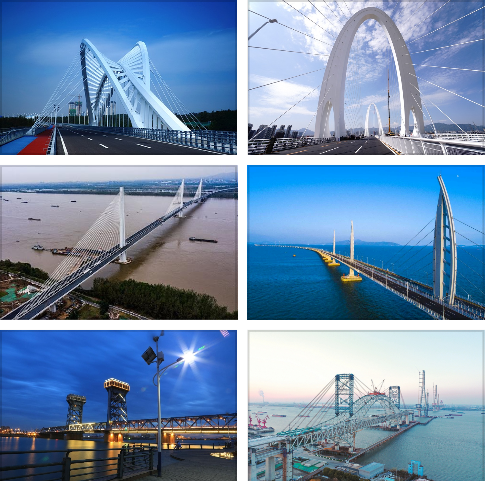
Bridges generally refer to structures erected over rivers, lakes and seas to enable vehicles and pedestrians to pass smoothly. It is an important part of the modern transportation industry. For example, our common railway bridges, highway bridges, sea-crossing river bridges, etc., provide great convenience for our long-distance travel and promote the rapid development of modern economy.
Bridges are divided by material, mainly including wooden bridges, steel structure bridges, and reinforced concrete bridges.
Wooden bridges were the earliest form of bridges due to the convenience of materials and simple harvesting and processing. It has the advantages of light weight, high strength, simple processing, and easy dismantling. However, because it is easy to corrode, flammable, and has insufficient bearing capacity and durability, few bridges now use wooden bridges.
Reinforced concrete bridge, a bridge whose span structure is made of prestressed concrete. It has the advantages of high strength, low maintenance cost, low driving noise, strong and durable. The disadvantages are heavy weight, complex construction technology and long construction period.
Steel structure bridges are bridges built with steel structures. Generally, such bridges use more than 50% of the total steel and are called “large steel structure bridges”. Its main body is made of alloy steel, and the parts are assembled and welded after production. It is a relatively fashionable new bridge construction method at present.
Steel structure bridges are the most commonly used in bridge construction, especially large-span bridges. They are not only strong and durable, but also unique and beautiful in shape, and are deeply loved by the public.
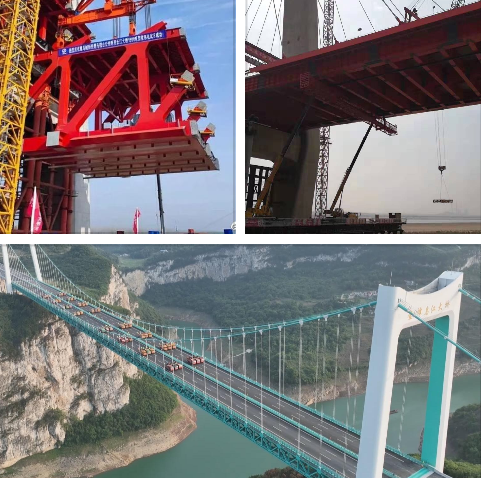
The main advantages of steel structure bridges are:
- It has high compressive: tensile and shear strength, is strong and safe, and is suitable for bridge infrastructure construction with large loads. It is also light in weight, making transportation, installation and construction simple and convenient.
- Good plasticity and ductility: During the earthquake disaster, the steel structure will produce structural deformation and absorb the kinetic energy caused by the earthquake disaster. It has high plastic deformation and ductility, which can effectively improve the seismic grade characteristics of the bridge. Moreover, various shapes of construction can be carried out according to the design, making the bridge practical and beautiful.
- Short construction period: The steel structure components are all fabricated in the factory with high processing precision. After passing various quality inspections and acceptance, they are transported to the site for direct installation. The construction is simple and efficient, and no construction waste is produced.
- Environmental protection and energy saving: The old components disassembled in steel structure bridges can be recycled repeatedly, and steel structure bridges are easy to transform.
Steel structure bridges have more advantages than other materials, which is why steel structure bridges have become so popular in recent years. However, many bridges now use steel-concrete composite structures. The combination of the two materials gives full play to the advantages of concrete’s compression resistance and steel’s tensile properties, avoiding the problems of concrete tensile cracking and steel compression instability. Each material has its own advantages, and it mainly depends on which material is more suitable for the project.